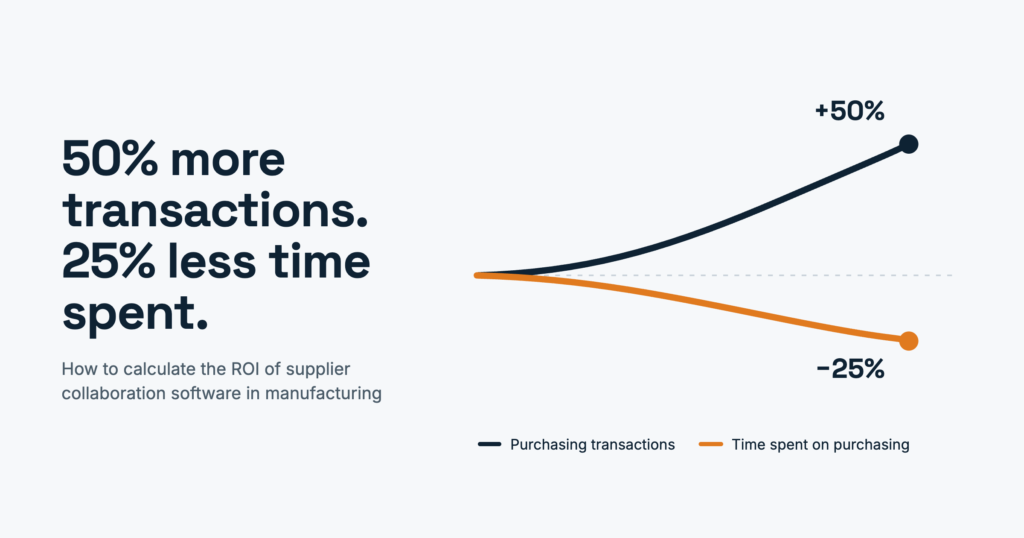
What if your purchasing team could handle 50% more transactions while spending 25% less time on purchasing? This is not a hypothetical scenario. It is a result achieved by many of our customers such as Fastems and Prima Power through digital supplier collaboration.
For manufacturing companies, investing in supplier collaboration software is not simply a technology decision. It is a business decision with measurable implications for productivity, delivery performance, quality and profitability. But how do you calculate the return on investment? And how do you build a business case that your CEO and CFO can support?
This guide provides a practical framework for evaluating the financial impact of supplier collaboration software.
The Hidden Cost of Manual Supplier Collaboration
Most manufacturing companies have invested heavily in ERP systems, production automation and internal process optimization. Yet collaboration with suppliers often relies on email, spreadsheets, manual data entry and disconnected systems.
Purchasing professionals spend a significant amount of time on activities such as:
- Sending purchase orders and following up on confirmations
- Manually updating order confirmations in ERP systems
- Searching for information across email conversations
- Communicating engineering changes
- Resolving delivery and quality issues
- Collecting supplier documentation
These activities are necessary, but many of them do not directly create additional value.
As the purchasing volumes grows, the workload increases. Without effective automation and collaboration, business growth can require additional administrative resources simply to maintain existing service levels.
The financial impact extends beyond purchasing salaries. Delayed information can affect production schedules, inventory levels, delivery reliability and customer satisfaction.
Five Areas Where Supplier Collaboration Creates Financial Value
1. Purchasing Productivity
Automating routine transactions and centralizing supplier communication can release purchasing capacity.
Instead of spending time chasing order confirmations, purchasers can focus on supplier development, sourcing strategies, negotiations and delivery optimization.
The business benefit can be expressed as released working hours, increased transaction capacity or avoided additional recruitment.
2. Purchase Order Automation
Purchase order processing involves more than creating an order in an ERP system.
Confirmations, delivery date changes, exceptions and communication between companies must also be managed.
By integrating supplier collaboration software with the existing ERP system, manufacturers can automate information flows while maintaining visibility across the purchasing process.
This reduces repetitive work and allows purchasers to focus on exceptions rather than individual transactions.
3. Improved Delivery Performance
When manufacturers and suppliers share accurate and timely information, both parties can respond earlier to potential delivery issues.
Better visibility reduces:
- Emergency purchasing
- Expedited transportation
- Production interruptions
- Administrative work related to delivery deviations
The financial impact should be calculated using the company’s actual historical costs and realistic improvement scenarios.
4. Reduced Cost of Poor Quality
Quality problems become more expensive when information is delayed, responsibilities are unclear or corrective actions are not properly managed.
A shared supplier collaboration environment supports faster communication, structured issue management and greater transparency.
Manufacturers can evaluate the potential financial benefit by analyzing supplier-related quality costs, including rework, rejected materials, warranty expenses and administrative effort.
5. Scalable Growth Without Proportional Headcount Growth
One of the most strategically important benefits of supplier collaboration software is the ability to increase purchasing capacity without increasing administrative resources at the same rate.
For a growing manufacturing company, this can represent substantial long-term value.
The objective is not necessarily to reduce the purchasing team. It is to enable the existing team to support a larger business while spending more time on activities that create competitive advantage.
How to Calculate Supplier Collaboration Software ROI
A practical ROI calculation starts with the current cost of manual processes.
The following example illustrates how a mid-sized manufacturing company could estimate the productivity value of digital supplier collaboration.
| Input | Example |
|---|---|
| Number of purchasers | 10 |
| Manual supplier-related work per purchaser per week | 20 hours |
| Working weeks per year | 46 |
| Fully loaded hourly cost | 50 € |
| Estimated reduction in manual work | 60% |
Based on these assumptions:
- Annual manual working hours: 9 200
- Annual working hours released: 5 520
- Annual productivity value: 267 000 €
This represents more than two thousand hours of purchasing capacity that could be redirected toward higher-value activities.
Importantly, this calculation does not include potential improvements in delivery performance, quality or inventory management.
Calculate your own supplier collaboration ROI and estimate the payback period!
Real Results from Manufacturing Companies
The value of supplier collaboration software is best demonstrated through actual manufacturing environments.
Fastems: Increasing Purchasing Capacity
Fastems reported a 50% increase in purchasing transaction volumes while reducing the time spent on purchasing by 25%.
Its experience demonstrates how digital supplier collaboration can improve productivity without requiring a proportional increase in administrative resources.
Read the Fastems success story
Prima Power: Improving Delivery Performance and Throughput
Prima Power reported several operational improvements after implementing Jakamo:
- More than double the previous purchase order throughput.
- A 15-percentage-point improvement in supplier on-time delivery.
- A 60% reduction in purchasers’ email traffic.
More than 90% of its purchase orders were managed through Jakamo.
Read the Prima Power success story
Stera Technologies: Automating Order Confirmations
Stera Technologies processes approximately 90,000 purchase order lines annually.
Among suppliers using Jakamo, almost all order confirmations became automated. Supplier adoption reached 98% of the invited companies.
Purchasers were able to redirect their attention toward delivery optimization, change management and supplier development.
Read the Stera Technologies success story
These are individual customer outcomes, not guaranteed results. However, they illustrate the types of measurable improvements manufacturers can evaluate when building their own business case.
Building a Business Case for Your CEO and CFO
A successful investment proposal should connect operational improvements with financial and strategic business objectives.
| Operational improvement | Business impact |
|---|---|
| Less manual purchasing work | Increased productivity |
| Automated order confirmations | Greater transaction capacity |
| Improved delivery visibility | Reduced operational disruption |
| Faster quality issue resolution | Lower cost of poor quality |
| Better supplier engagement | Greater collaboration efficiency |
| Scalable purchasing processes | Growth without proportional headcount increases |
The business case should also account for implementation, ERP integration, training, supplier onboarding and recurring software costs.
A complete evaluation considers both the investment required and the organization’s ability to realize the expected benefits.
Released working hours should not automatically be treated as direct cash savings. Their financial value depends on how the organization uses the additional capacity.
Do You Need to Replace Your ERP?
No. Supplier collaboration software complements the existing ERP system.
The ERP remains the system of record for internal purchasing and business processes. Jakamo extends these processes into the supplier network, creating a shared environment for transactions, communication and collaboration.
This allows manufacturing companies to improve supplier-facing processes without replacing their existing ERP infrastructure.
Learn more about purchase order integration with ERP
Why Supplier Adoption Matters for ROI
Even the most advanced automation technology delivers limited value if suppliers do not adopt it.
The business case should therefore evaluate not only the software’s functionality but also the supplier engagement and experience.
A platform that makes collaboration easier for both manufacturers and suppliers creates a stronger foundation for adoption and sustainable process improvements.
This is one of the key differences between traditional company-specific supplier portals and a shared supplier collaboration platform.
Frequently Asked Questions
What is the ROI of supplier collaboration software?
ROI depends on purchasing volumes, current manual workload, implementation costs, supplier adoption and realized operational improvements. Manufacturers can estimate ROI by comparing measurable annual benefits with the total investment required.
How do you calculate procurement automation ROI?
Calculate the working hours released through automation, multiply them by the fully loaded hourly cost and add other independently measurable benefits. Subtract the total investment and divide the resulting net benefit by the investment.
How quickly can supplier collaboration software deliver value?
The time to value depends on ERP integration, implementation scope, supplier onboarding and adoption. A phased implementation can help manufacturers start realizing benefits from selected processes before expanding across the supplier network.
What costs should be included in the business case?
Include software subscriptions, implementation, integrations, internal project resources, training and ongoing maintenance where applicable.
Can supplier collaboration software improve profitability?
It can contribute to profitability through greater productivity, reduced operational costs and improved purchasing capacity. The actual impact depends on how effectively the company converts operational improvements into financial benefits.
Build Your Supplier Collaboration Business Case with Jakamo
The most useful ROI calculation is based on your company’s actual processes, supplier network and business objectives.
Jakamo’s experts help manufacturing companies evaluate where digital supplier collaboration can create measurable operational and financial value.
Together, we can identify opportunities for automation, improved purchasing productivity and more effective collaboration across your supplier network.
Request a Personalized ROI Assessment.
Contact us sales@thejakamo.com and let’s discover together what digital supplier collaboration could mean for your business!