
What manufacturing leaders discussed at Supplier X Roundtable 2025
Jakamo brought together 100 procurement, supply chain, sourcing, sustainability, and supplier collaboration professionals from manufacturing companies for a full-day workshop and roundtable discussion focused on the future of strategic supplier management.
The discussions were highly practical. Instead of talking about abstract supply chain trends, participants focused on the real operational challenges they are currently facing inside manufacturing organizations and supplier networks.
Across all conversations, four major themes emerged repeatedly.
Supplier Sustainability Data Is Still Inconsistent
One of the strongest discussion themes focused on the reliability of supplier sustainability and CO2 emissions data.
Many participants described situations where suppliers provide emissions data calculated using completely different methodologies. Some companies rely on highly accurate primary data based on actual production or material information, while others use secondary sources, industry averages, or external databases.
The result is that procurement teams often struggle to compare suppliers fairly. Two suppliers may report very different emissions numbers even when the actual environmental impact is relatively similar.
Several participants also pointed out that transportation emissions can completely change the sustainability picture. A product that appears low-emission on paper may become a poor overall choice if logistics emissions are significant.
Another recurring concern was that sustainability evaluations can sometimes become too superficial. Companies investing heavily in better processes and more accurate reporting are not always rewarded in supplier comparisons, especially if buyers only look at headline numbers without understanding how the calculations were made.
The discussions highlighted a growing need for more transparency, more structured supplier sustainability collaboration, and better ways to integrate sustainability data into everyday procurement processes instead of treating it as a separate reporting exercise.
Supplier Data Collection Is Becoming Unsustainable
Supplier data collection was another topic that generated extensive discussion throughout the day.
Many participants felt that manufacturing companies are approaching a point where supplier questionnaires and reporting requests are becoming too heavy for both sides. Suppliers may be asked to provide dozens of datapoints related to sustainability, compliance, quality, operations, and sourcing — often repeatedly.
Several attendees noted that the same information is frequently requested again simply because previous data cannot be found easily or is scattered across different systems, spreadsheets, and email chains.
This creates frustration not only internally but also among suppliers. Some participants openly questioned whether organizations are already collecting more supplier data than they can realistically utilize.
The conversation also touched on supplier experience. Repetitive reporting requests increase administrative workload and can weaken collaboration over time. When suppliers feel they are constantly answering disconnected questionnaires without seeing clear value, engagement naturally starts to decline.
There was broad agreement that supplier data management needs to become more structured, more centralized, and more connected to actual operational workflows. Several participants emphasized that sustainability and supplier information should ideally be collected as part of normal procurement and collaboration processes rather than through separate reporting exercises.
Suppliers Should Be Seen as Growth Partners
One of the most interesting discussions focused on how suppliers are viewed inside manufacturing organizations.
An example shared during the workshop described a company leadership team that had identified more than 30 supply chain related risks, but almost no supplier-related growth opportunities. This sparked a wider conversation around how suppliers are often viewed primarily through the lens of risk management, compliance, and cost control.
Many participants felt that this mindset leaves significant value untapped.
The discussion shifted toward the idea that suppliers can also play an important role in enabling growth, innovation, scalability, and operational flexibility. Several attendees shared examples where suppliers had invested in new capabilities, equipment, or workforce after gaining better visibility into future customer plans and long-term cooperation opportunities.
Communication, transparency, and trust were repeatedly mentioned as critical factors behind successful supplier collaboration. Participants emphasized that suppliers are much more willing to invest and innovate when they understand where the customer is heading and how they can contribute to future success.
There was also growing interest around more collaborative ways of working, including joint development initiatives, design for manufacturability, design for sustainability, and supplier capability development.
A recurring conclusion throughout the discussion was that companies treating suppliers as strategic partners instead of isolated vendors are often in a much stronger position to scale and adapt in changing markets.
Improving Supply Chain Performance Objectives Requires More Than Hiring
The final major theme focused on growth and scalability.
One example discussed during the workshop involved a defense industry company that had previously faced severe operational difficulties before experiencing a sudden surge in demand. Like many fast-growing manufacturing companies, the organization faced a difficult question: should investments focus primarily on hiring more people or improving processes, systems, and operational visibility?
Most participants agreed that hiring alone is rarely enough.
As manufacturing organizations grow, operational complexity increases rapidly. Supplier-related information often becomes dependent on individual employees, undocumented communication, and fragmented tools. This creates risks, slows decision-making, and makes scaling more difficult.
Several participants emphasized that better supplier collaboration processes, shared visibility, and automation are becoming increasingly important as organizations grow. The goal is not simply to reduce manual work, but to ensure that supplier-related knowledge, communication, and decision-making do not remain trapped inside individual teams or employees.
The discussions highlighted that improving supply chain performance increasingly requires a balanced combination of people, processes, collaboration, and digital tools. Companies that succeed in scaling supplier operations are often those that can improve transparency and structure without making collaboration more complicated.
The Future of Strategic Supplier Management
The Supplier X Roundtable discussions revealed a clear shift taking place across manufacturing industries.
Strategic supplier management is no longer viewed only as a procurement or compliance function. It is increasingly connected to growth, resilience, sustainability, innovation, and long-term competitiveness.
The conversations also showed that manufacturing companies are looking for more practical and collaborative approaches to supplier management — especially in areas such as sustainability data, supplier collaboration, operational visibility, and scalable processes.
As supply chains become more complex, organizations that can combine collaboration, structured supplier information, and operational transparency are likely to build a significant competitive advantage in the years ahead.
Strategic Supplier Management Directly Impacts SCM Performance Objectives
Another theme during the Supplier X discussions was that supplier collaboration is no longer viewed as a separate procurement activity. It is increasingly tied directly to broader supply chain management performance objectives.
Participants highlighted that improving supply chain performance requires balancing several interconnected factors simultaneously. Cost efficiency remains important, but organizations are also under pressure to improve delivery reliability, adaptability, product quality, operational speed, and sustainability — often at the same time.
Many attendees emphasized that supplier collaboration has a direct influence on all of these areas.
For example, reliable supplier communication and shared visibility can improve delivery dependability and reduce operational disruptions. Better collaboration and structured supplier processes can accelerate throughput and improve responsiveness during sudden market changes. Sustainability initiatives increasingly depend on supplier transparency and the ability to collect accurate operational and emissions-related data across the supply chain.
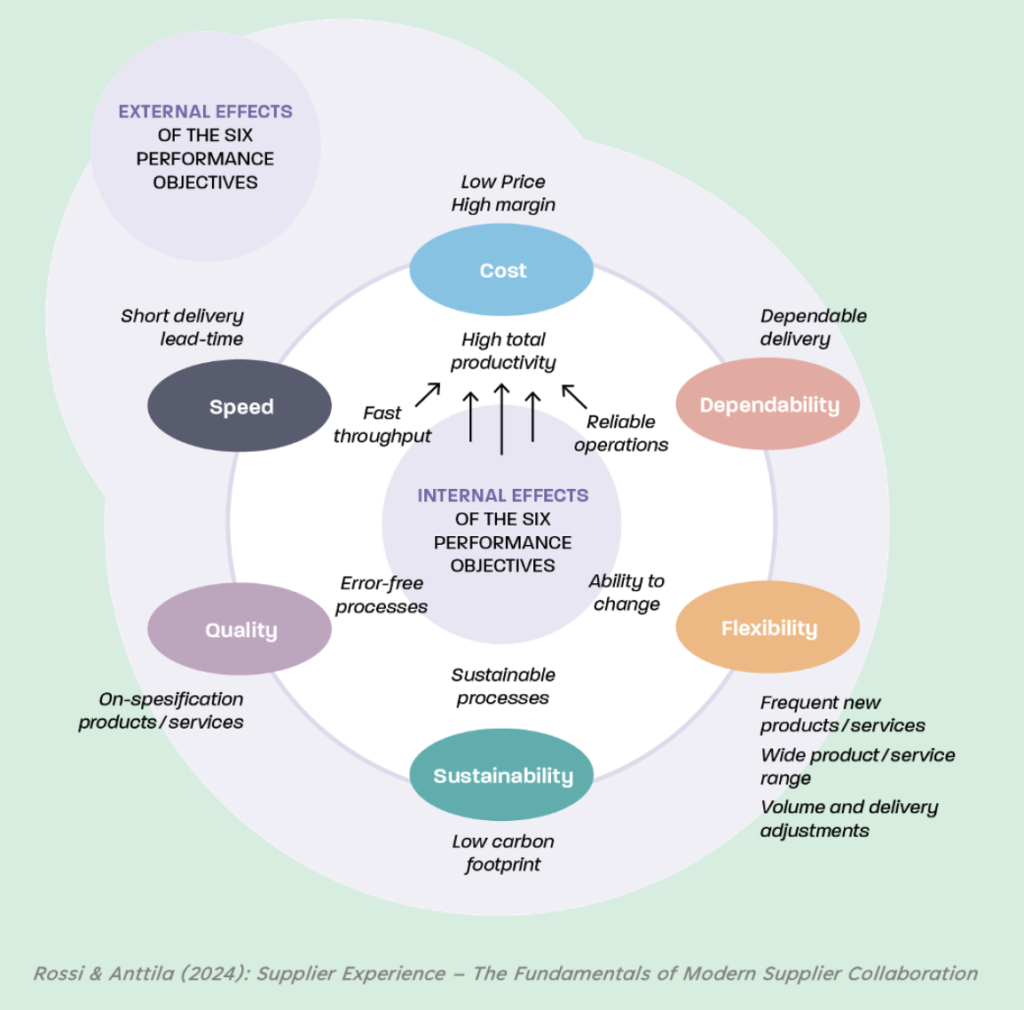
The discussions also reinforced the idea that supply chain performance cannot be improved only through internal optimization. Supplier networks play a critical role in:
- operational flexibility
- sustainable processes
- reliable delivery performance
- quality consistency
- scalability during growth periods
Several participants noted that as manufacturing environments become more complex, supplier collaboration itself is becoming a strategic operational capability rather than simply a sourcing function.
According to the discussions, organizations that successfully align supplier collaboration with clear and focused SCM performance objectives are often better positioned to improve productivity, resilience, and long-term competitiveness simultaneously.
Want to exchange ideas around supplier collaboration, sustainability data, or supply chain scalability?
Explore how leading manufacturing companies are improving supplier collaboration, sustainability transparency, and supply chain visibility: References