Track and Monitor Scope 3 Emissions Across Your Supplier Network
Scope 3 emissions are the largest and most complex part of most companies’ carbon footprint. Yet they are also the hardest to measure, manage, and improve.
Maybe your organization already understands the importance of Scope 3 emissions. The real challenge is not awareness, it is execution. Good News: You are in the right place.
Collecting emissions data from suppliers, ensuring consistency, and monitoring changes over time requires structured processes and the right tools.
We help companies track and monitor Scope 3 emissions by enabling structured supplier data collection and collaboration — all in one place.
What Is Scope 3 Emissions Tracking?
Scope 3 emissions tracking refers to the process of identifying, collecting, measuring, and continuously monitoring the greenhouse gas emissions generated across a company’s entire value chain.
Unlike Scope 1 emissions (direct emissions from owned operations) and Scope 2 emissions (emissions from purchased energy), Scope 3 emissions are created outside the company’s direct control — but still as a consequence of its business activities.
This makes Scope 3 tracking fundamentally a supplier collaboration and data management challenge, not just a sustainability reporting exercise.
For manufacturers and industrial companies especially, the majority of environmental impact often comes from purchased materials, components, transportation, supplier manufacturing processes, and product lifecycle emissions rather than from internal factory operations alone.
Typical Scope 3 emission sources include:
- Purchased goods and services
- Raw materials and components
- Supplier manufacturing operations
- Transportation and logistics
- Business travel
- Waste generated in operations
- Product use phase
- End-of-life treatment and recycling
- Capital goods and infrastructure investments
According to the Greenhouse Gas Protocol, Scope 3 includes 15 different emission categories covering both upstream and downstream activities. This means companies must often gather emissions-related data from hundreds or even thousands of suppliers across multiple countries and tiers of the supply chain.
For many industries, Scope 3 emissions represent more than 70–90% of total corporate emissions — making them the single most important area for achieving meaningful sustainability improvements.
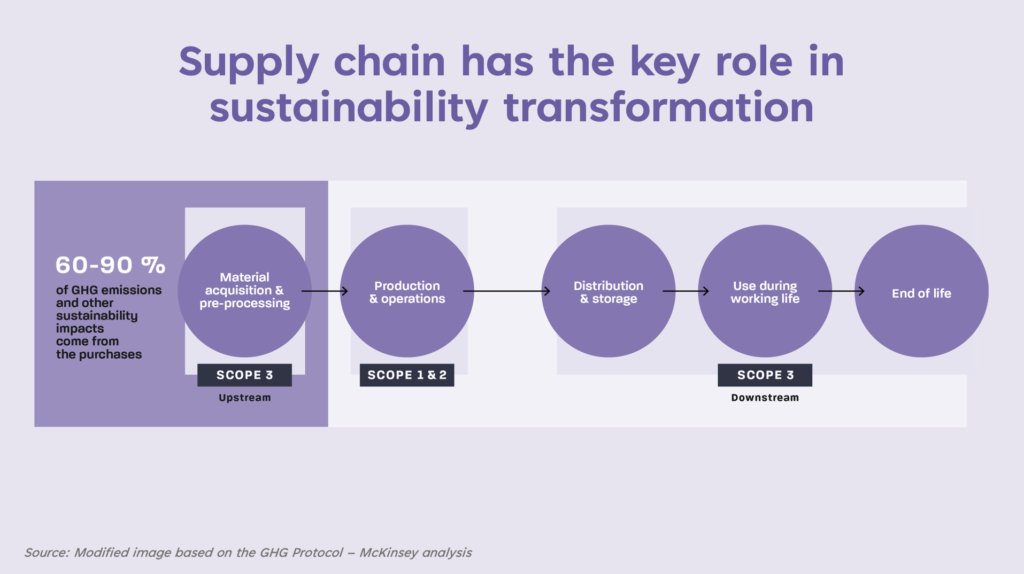
This is why Scope 3 emissions tracking is becoming a strategic business capability rather than just a compliance requirement.
Companies are increasingly expected to:
- Collect supplier-specific emissions data
- Monitor sustainability performance continuously
- Improve supply chain transparency
- Identify high-emission suppliers and materials
- Support CSRD, ESG, and customer reporting requirements
- Reduce supply chain risks and carbon exposure over time
The challenge is that most organizations still manage supplier sustainability data through emails, spreadsheets, PDFs, and disconnected systems. As supplier requirements increase, manual processes quickly become unsustainable.
Effective Scope 3 emissions tracking therefore requires:
- Structured supplier collaboration
- Standardized data collection
- Continuous supplier engagement
- Centralized sustainability data management
- Integration into procurement and sourcing processes
Without scalable supplier collaboration, Scope 3 reporting becomes slow, inconsistent, and difficult to maintain as regulations and customer expectations continue to evolve.
What Is Scope 3 Emissions Monitoring?
While tracking focuses on collecting and structuring data, Scope 3 emissions monitoring refers to the continuous process of:
- Updating emissions data
- Following changes over time
- Identifying risks and inconsistencies
- Ensuring ongoing compliance and transparency
In practice, tracking and monitoring go hand in hand. Without continuous monitoring, emissions data quickly becomes outdated, incomplete, and unreliable.
Why Scope 3 Emissions Tracking Is So Difficult
Most companies do not struggle because they lack ambition. They struggle because Scope 3 emissions tracking is fundamentally a supplier data challenge. This is why this has to become a part of normal supplier collaboration.
Typical challenges include:
1. Supplier Data Is Missing
Suppliers often do not have standardized emissions data available. In many cases, data must be requested, estimated, or calculated.
2. Data Is Scattered Across Systems
Information is spread across emails, spreadsheets, ERP systems, and documents. There is no single source of truth.
3. No Standardized Data Collection Process
Different suppliers provide data in different formats, making it difficult to compare, validate, and use.
4. Manual Work Slows Everything Down
Collecting data via email and Excel requires constant follow-ups, reminders, and manual consolidation.
5. Monitoring Is Nearly Impossible
Even if data is collected once, keeping it updated over time becomes a major challenge.
Without structured processes, Scope 3 emissions tracking becomes slow, expensive, and unreliable.
How to Track and Monitor Scope 3 Emissions
Most companies already understand why Scope 3 emissions matter.
The real challenge is operational:
How do you actually collect reliable emissions data from hundreds of suppliers without creating a massive manual workload?
For most manufacturing companies, Scope 3 emissions tracking quickly becomes a supplier collaboration problem rather than a pure sustainability exercise.
A practical process usually looks something like this:
Start With the Biggest Impact Areas
Trying to collect everything from every supplier at once usually leads to delays, low response rates, and incomplete data.
Most companies begin by focusing on suppliers, materials, or categories that have the largest environmental impact or the highest reporting pressure.
This often means:
- High-spend suppliers
- Emissions-intensive materials or components
- Suppliers in critical product categories
- Logistics and transportation partners
- Suppliers already requested by customers or regulators
The goal is not perfection on day one.
The goal is visibility into the areas that matter most.
Make Supplier Data Collection Repeatable
One of the biggest challenges in Scope 3 reporting is that supplier data is often scattered across emails, Excel files, PDFs, ERP exports, and sustainability questionnaires.
When every supplier sends information in a different format, reporting quickly becomes difficult to maintain.
This is why companies increasingly move toward structured supplier data collection processes where suppliers can submit:
- Emissions data
- REACH and RoHS information
- Product-level sustainability information
- Certifications and compliance documents
- Carbon footprint values
- Material declarations
- Country of origin
in a standardized way.
Without structure, scaling Scope 3 reporting becomes extremely resource-intensive.
Turn Sustainability Data Into Continuous Supplier Collaboration
Scope 3 emissions monitoring is not a once-a-year reporting exercise.
Supplier data changes continuously:
- Materials change
- Suppliers change
- Manufacturing locations change
- Emission factors evolve
- Regulations expand
- Customer requirements increase
This means sustainability data management needs to become part of ongoing supplier collaboration instead of isolated reporting projects.
The companies that succeed are typically the ones that integrate sustainability communication directly into procurement and supplier management processes.
Centralize Supplier Sustainability Data
Another common problem is fragmented visibility.
Procurement teams, sustainability teams, quality teams, and sourcing managers often work with separate spreadsheets and disconnected systems.
Centralizing supplier sustainability data helps companies:
- Improve transparency across the organization
- Reduce duplicate supplier requests
- Monitor supplier responsiveness
- Identify missing or outdated information
- Support CSRD, ESG, and customer reporting requirements more efficiently
More importantly, centralized data creates a foundation for long-term supply chain sustainability improvements instead of temporary reporting exercises.
Focus on Data Quality Over Data Volume
Many organizations initially focus on collecting as much supplier data as possible.
In practice, data consistency and reliability matter far more than the sheer amount of information collected.
Incomplete, outdated, or incomparable supplier data creates reporting risks and weakens decision-making.
This is why scalable Scope 3 emissions tracking requires:
- Standardized supplier processes
- Clear ownership
- Continuous updates
- Supplier engagement
- Consistent validation practices
Without these, Scope 3 monitoring easily turns into a yearly spreadsheet exercise that consumes enormous amounts of time but produces limited strategic value.
From Manual Tracking to Structured Monitoring
Many companies begin Scope 3 emissions tracking using spreadsheets and email communication.
While this may work initially, it quickly becomes unmanageable as supplier networks grow.
The main issue is not the calculation of emissions — it is the collection and management of supplier data.
Without a structured system:
- Data becomes outdated
- Processes break down
- Visibility is lost
To scale Scope 3 emissions tracking and monitoring, companies need a structured approach to supplier collaboration.
Scope 3 Emissions Tracking with Jakamo
Jakamo helps companies collect, manage, and monitor supplier emissions data in a structured and scalable way. Instead of chasing information, companies can build a repeatable process that integrates into their existing supplier collaboration.
With Jakamo, you can:
- Collect supplier sustainability data in a structured format embedded in existing processes
- Send standardized data requests to suppliers
- Centralize all supplier information in one place
- Ensure traceability across your supply chain
- Monitor data continuously and keep it up to date
Built into your daily supplier collaboration — not a separate system or extra process.
Why Companies Choose Jakamo for Scope 3 Emissions Tracking
Companies choose Jakamo because it solves the real bottleneck: supplier data collection and collaboration.
Key benefits include:
- Reduce manual work and internal coordination
- Eliminate scattered, email-based communication
- Improve the quality and completeness of supplier data
- Speed up Scope 3 emissions tracking and validation
- Increase transparency across the supply chain
- Be better prepared for audits and reporting
- Increase strategic competitiveness in the markets
Turn Scope 3 emissions tracking into a natural part of your supplier collaboration — not a separate project.
Scope 3 Emissions Tracking: Excel vs Structured System
Many organizations start with Excel.
But there are clear limitations.
Excel-Based Approach
- Manual data collection
- High risk of errors
- Difficult to scale
- Limited collaboration
- Hard to maintain over time
Structured System Approach (Jakamo)
- Standardized data collection
- Centralized and organized data
- Scalable across large supplier networks
- Built for collaboration
- Continuous monitoring and updates
As supplier networks grow, a structured system becomes essential.
Building a Sustainable Supply Chain Starts with Data
Scope 3 emissions tracking is not just about reporting. It is about building transparency and control across your supply chain. A sustainable supply chain requires:
- Reliable supplier data
- Continuous monitoring
- Strong collaboration
Without these elements, sustainability initiatives remain incomplete.
Frequently Asked Questions
What is Scope 3 emissions tracking?
Scope 3 emissions tracking is the process of collecting and managing indirect emissions data from across a company’s value chain, including suppliers, logistics, and product use.
What is Scope 3 emissions monitoring?
Scope 3 emissions monitoring refers to the continuous updating and tracking of emissions data over time to ensure accuracy, transparency, and compliance.
Why is Scope 3 emissions tracking so difficult?
Because it depends on supplier data. Collecting, standardizing, and maintaining this data across multiple suppliers is complex without structured processes.
How do companies collect Scope 3 emissions data?
Typically through supplier requests, data collection templates, and collaboration systems that allow structured input and validation.
Can Scope 3 emissions be tracked in Excel?
For small supplier networks, partially. For larger or global supply chains, a structured system is required to ensure scalability and data quality.
Make Scope 3 Emissions Tracking Manageable
Scope 3 emissions tracking does not have to be overwhelming.
With the right structure and tools, it becomes part of your normal way of working with suppliers.
Instead of chasing data, you build a system that continuously collects, updates, and improves it.
If you want to see how this works in practice:
Want help with supply chain sustainability? We created a free 5-day playbook with actionable lessons that help you move from “we should do something” to knowing exactly what to do next. Click this link to get instant access.